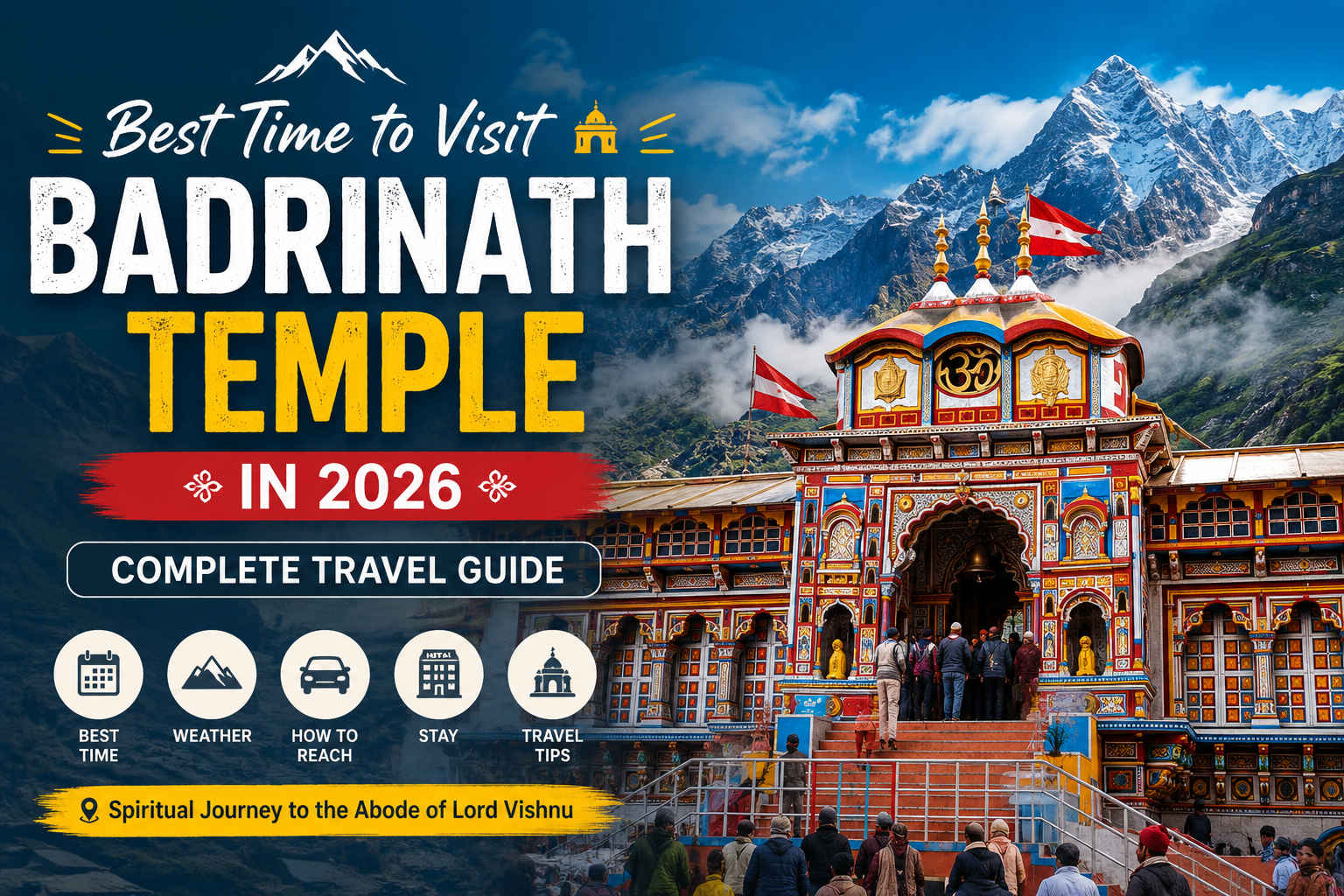
Best Time to Visit Badrinath Temple in 2026 – Complete Travel Guide
Introduction
Nestled at an altitude of 3,133 metres in the Chamoli district of Uttarakhand, Badrinath Temple is one of the most sacred pilgrimage destinations in India. As one of the Char Dham shrines and a vital stop on the Chota Char Dham Yatra package from delhi, this ancient temple dedicated to Lord Vishnu draws lakhs of devotees every year from across the country.
But knowing the best time to visit Badrinath Temple can make the difference between a deeply fulfilling spiritual journey and a stressful, uncomfortable experience. Whether you’re planning a solo pilgrimage, a family trip, a couple’s getaway, or a senior-friendly tour — choosing the right season is absolutely key.
This comprehensive guide for 2026 covers everything you need: weather season-by-season, crowd levels, VIP darshan booking, how to travel from Delhi, places to explore around Badrinath, safety tips, budget estimates, and a ready-to-use itinerary. Let’s plan your perfect Badrinath yatra.
Table of Contents
1. Why Badrinath is a Must-Visit Pilgrimage {#why-badrinath-is-a-must-visit}
Badrinath holds a place of immense religious significance in Hinduism. It is:
One of the Char Dhams (four sacred abodes of Hinduism)
Part of the Chota Char Dham Yatra in Uttarakhand (along with Kedarnath, Gangotri, and Yamunotri)
One of the 108 Divya Desams (Vishnu temples)
Among the Panch Badri temples of Uttarakhand
The temple sits along the banks of the Alaknanda River, with the towering Neelkanth peak as a breathtaking backdrop. The idol of Lord Badrinarayan (Lord Vishnu) enshrined here is believed to be one of the self-manifested (Swayambhu) idols in Hinduism.
The temple was re-established by Adi Shankaracharya in the 8th century and has been a pilgrimage destination for over a thousand years. A visit here is considered to cleanse one’s sins and help attain moksha.
2. Best Time to Visit Badrinath Temple (Month-by-Month) {#best-time-to-visit-badrinath-temple}
The best time to visit Badrinath Temple is from May to June and again from September to October. However, the temple only remains open for around six months a year — typically from late April/early May to November — due to heavy snowfall during winter.
Here’s a detailed month-by-month breakdown:
May – June: Peak Pilgrimage Season (Best Overall)
The temple opens every year around late April or early May on Akshaya Tritiya, a highly auspicious day. By May, the weather is pleasant and the valley begins to bloom with wildflowers.
Temperature: 7°C to 18°C
Crowd Level: Very High in May; moderate-high in June
May is the most popular time to visit due to school vacations and the festive atmosphere around the temple’s opening. Book hotels and transport well in advance if visiting in May.
July – August: Monsoon Season (Proceed with Caution)
The monsoon brings heavy rainfall to the Uttarakhand hills, increasing the risk of landslides, road blockages, and floods.
Temperature: 10°C to 16°C
Crowd Level: Low to Moderate
Weather: Heavy rainfall, foggy, landslide-prone roads
Ideal For: Adventure seekers with flexible plans; NOT recommended for families or seniors
The Rishikesh–Badrinath highway (NH 58 / NH 7) can get blocked for hours or days during July and August due to landslides near Devprayag, Rudraprayag, Chamoli, and Joshimath. If you do visit during this period, keep extra days as buffer and stay updated on SDRF alerts.
September – October: Post-Monsoon Sweet Spot (Second Best)
After the monsoon retreats, Badrinath enters its second golden season. The skies clear up, roads stabilise, and the landscape turns lush green. October is especially popular because devotees flock for the temple closing ceremony (Diwali period).
Temperature: 5°C to 15°C
Crowd Level: Moderate in September; High in October
Weather: Clear, crisp, excellent views of snow-capped peaks
Ideal For: Couples, photographers, those avoiding peak crowds
Pro tip: Late September and early October is arguably the finest time to visit — the crowds of May are gone, the roads are safe, and the views are spectacular.
November: Closing Month (For the Adventurous)
The temple usually closes on Vijaya Ekadashi (in October-November) with elaborate rituals. By mid-November, heavy snowfall begins, making roads dangerous.
Temperature: -5°C to 8°C
Crowd Level: Very Low
Weather: Cold, snow begins to fall
Ideal For: Witnessing the closing ceremony (plan very carefully)
December – March: Temple Closed
The temple remains fully closed during winter. The idol of Lord Badrinath is ceremonially transferred to Joshimath’s Narasimha Temple where worship continues until the Badrinath temple reopens.
3. Can We Visit Badrinath in April? {#can-we-visit-badrinath-in-april}
This is one of the most searched questions among pilgrims planning early trips. Here’s the honest answer:
Yes and No — it depends on the exact date.
The Badrinath temple generally opens in the third or fourth week of April (on Akshaya Tritiya). In 2026, the expected opening date is around April 29 – May 2 (official dates are announced by the Badrinath-Kedarnath Temple Committee closer to the event).
Early April (1st–20th): Temple is closed. Roads may be snow-covered and blocked.
Late April (after temple opening): Yes, you can visit! The opening day itself is a highly charged, spiritually powerful experience with thousands of devotees.
If you want to visit in April, wait for the official opening date announcement and plan your trip for the opening week. It’s a once-in-a-year moment when the idol is unveiled after six months, the first aarti is performed, and the entire valley reverberates with devotional fervour.
4. Best Time to Visit Badrinath with Less Crowd {#best-time-to-visit-badrinath-with-less-crowd}
If you prefer a quieter, more meditative pilgrimage, here are the least crowded times to visit Badrinath:
Early September – After the peak monsoon. Roads are stable, crowds thin out from the July rush. Peaceful and beautiful.
Late October (post-Navratri) – After the Navratri festival surge. Still warm enough to travel comfortably.
Weekdays in June – If you must visit in summer, go on a Tuesday, Wednesday, or Thursday. Avoid weekends and public holidays.
Morning slots (5:00 AM – 7:00 AM) – Even during busy seasons, the early morning Abhishek Darshan and Aarti sessions are less crowded than afternoon visits.
The busiest days at Badrinath are:
Opening day of the temple
Closing day of the temple
Weekends throughout May and June
Akshaya Tritiya
Any major Hindu festival during the open season
5. Best Time to Visit Badrinath and Kedarnath Together in 2026 {#best-time-to-visit-badrinath-and-kedarnath-2026}
Combining both temples into one Char Dham or Do Dham Yatra is extremely popular among Indian pilgrims. Here’s how to plan it optimally in 2026.
Recommended Combined Window: May 10 – June 15, 2026
Both temples are open and the weather is cooperative during this period. The standard route is:
Total Drive Time: 16–18 hours (best split over 2 days)
Recommended stoppages:
Night 1: Haridwar or Rishikesh
Night 2: Rudraprayag or Chamoli
Day 3: Reach Badrinath
You can hire a Tempo Traveller, Innova, or Swift Dzire from Delhi. Shared taxis are also available from Haridwar/Rishikesh to Badrinath.
Option 2: By Train + Road
Take an overnight train from Delhi (New Delhi / Hazrat Nizamuddin) to Haridwar or Rishikesh
Popular trains: Shatabdi Express, Dehradun Express, Haridwar Express
From Haridwar/Rishikesh, hire a cab or take a bus to Badrinath (280–300 km further)
Option 3: By Flight + Road
Fly from Delhi to Jolly Grant Airport, Dehradun (45–60 minutes)
Then drive via Rishikesh → Badrinath (~280 km, 8–9 hours)
This option is best for those with limited time
Option 4: Helicopter Service
GMOU and several private operators offer helicopter service to Badrinath from Haridwar and Dehradun (Sahastradhara), especially during peak season. Prices start around ₹6,000–₹9,000 per person one-way.
UPSRTC / GMOU Buses
Government buses run from ISBT Kashmere Gate (Delhi) to Badrinath and Joshimath during the yatra season. These are economical (fare ~₹700–₹1,200) but journeys are very long (20–24 hours).
Getting a smooth darshan at Badrinath requires advance planning, especially during peak season.
Types of Darshan at Badrinath
Darshan Type
Cost
Duration
Notes
General Darshan
Free
1–3 hours wait
Standard queue, sometimes very long
Abhishek Darshan
₹500–₹600 per person
30–45 min wait
Includes special rituals
VIP/Special Darshan
₹1,500–₹3,000 per person
15–20 min wait
Priority entry, close-up view of idol
Nirvan Darshan (Early Morning)
₹500–₹700
6:30 AM slot
Holy bath ritual viewing
How to Book VIP Darshan
Online: Visit the official Badrinath Kedarnath Temple Committee (BKTC) website: badrinath-kedarnath.gov.in
On-site: VIP passes can also be obtained from the temple office counter at Badrinath, subject to availability
Through your tour operator: Travel companies like TravelsYatra can arrange VIP darshan as part of the package
Book VIP darshan at least 2–4 weeks in advance during May and October to avoid disappointment.
Temple Opening and Closing Timings (Daily Schedule)
Session
Time
Mahabhishek (Special Puja)
4:30 AM – 6:30 AM
Nirvan Darshan
6:30 AM – 7:00 AM
General Darshan (Morning)
7:00 AM – 12:00 PM
Afternoon Closure (Bhog)
1:00 PM – 4:00 PM
General Darshan (Evening)
4:00 PM – 9:00 PM
Aarti / Closing Ceremony
8:30 PM – 9:00 PM
Note: Timings are subject to seasonal adjustments. Always confirm before visiting.
8. Badrinath Temple Visit Time {#badrinath-temple-visit-time}
Ideal Time of Day for Darshan
The best time for darshan within a day is:
Early Morning (6:30 AM – 9:00 AM): The most serene and spiritually powerful experience. Queues are shorter, air is fresh, and the first morning aarti is mesmerising.
Late Evening (6:30 PM – 9:00 PM): The evening aarti (Shringar Aarti) is a breathtaking ceremony when the idol is adorned and the ghee lamps illuminate the sanctum.
Avoid visiting between 10:00 AM and 12:00 PM during peak season — this is when the longest queues form.
9. Places to Visit in Badrinath {#places-to-visit-in-badrinath}
Badrinath is far more than just the main temple. The surrounding area is rich with natural beauty, spiritual sites, and trekking trails.
1. Mana Village
Just 3 km from Badrinath, Mana is the last inhabited village before the Indo-Tibetan border. It’s home to the legendary Vyas Gufa (where Sage Vyas wrote the Mahabharata), Ganesh Gufa, Bhim Pul (a natural rock bridge), and Saraswati River. It’s a must-visit extension to any Badrinath trip.
2. Tapt Kund
A natural hot-water spring right below the Badrinath Temple. Pilgrims traditionally take a dip here before darshan. The water is believed to have medicinal properties and remains warm even in freezing temperatures (around 45°C).
3. Brahma Kapal
A flat sacred platform on the banks of the Alaknanda River where Hindus perform pind daan (ancestral rituals). Many families conduct their ancestral rites here.
4. Neelkanth Peak
The majestic snow-capped “Queen of Garhwal” peak at 6,596 metres forms a stunning backdrop to the Badrinath temple. Visible from the temple courtyard, it is a favourite subject for photographers.
5. Vasudhara Falls
Located 9 km from Badrinath (via Mana village), this 122-metre cascade falls from a height with the backdrop of snow peaks. It’s a moderate hike and rewarding for those with energy. According to legend, the water bypasses those who have sinned.
6. Satopanth Lake
A high-altitude glacial lake at 4,402 metres, about 24 km from Badrinath. A 3–4 day trek for serious trekkers. The lake is considered the site where Lord Brahma, Vishnu, and Shiva take a ceremonial dip on Akshaya Tritiya.
7. Charan Paduka
Located 3 km from Badrinath at 3,380 metres, this rock bears the imprint of Lord Vishnu’s feet. A gentle uphill walk with panoramic views.
8. Panch Dhara
Five waterfalls — Preet Dhara, Indira Dhara, Urvashi Dhara, Shesh Netra Dhara, and Pur Dhara — located near the temple. Each has its own mythological significance.
10. Recommended Hotels in Badrinath {#recommended-hotels}
Accommodation options in Badrinath range from budget dharamshalas to comfortable mid-range hotels. There are no 5-star properties here — it is a pilgrimage town.
Property
Category
Approx. Price/Night
Highlights
Hotel Devlok
Mid-Range
₹2,500–₹4,000
Good views, decent facilities
Hotel Snow Crest
Budget
₹1,200–₹2,000
Clean rooms, close to temple
GMVN Tourist Bungalow
Budget–Mid
₹1,500–₹3,500
Government guesthouse, reliable
Brahmakamal GMVN
Budget
₹1,000–₹1,800
Basic, government-run
Hotel Alka
Mid-Range
₹2,000–₹3,500
River views, warm staff
Book accommodation at least 4–6 weeks in advance during May, June, and October. Many hotels fill up weeks before peak season.
For a more comfortable stay with better facilities, Joshimath (45 km from Badrinath) is a popular base. It has hotels like Hotel Kamet and Hotel Nanda Devi with better amenities and reliable connectivity.
11. Sample 5-Night 6-Day Badrinath Itinerary from Delhi {#sample-itinerary}
This itinerary is designed for families, couples, and small groups combining comfort with spiritual depth.
Day 1: Delhi to Haridwar/Rishikesh
Depart Delhi by overnight train or early morning drive
Check in at Haridwar or Rishikesh
Evening: Attend the famous Ganga Aarti at Har Ki Pauri (Haridwar) — a soul-stirring experience
Night stay: Haridwar
Day 2: Haridwar to Rudraprayag (via Devprayag)
Drive along the beautiful Alaknanda Valley
Stop at Devprayag — the divine confluence of Bhagirathi and Alaknanda rivers (the origin point of the Ganga)
Visit Rudraprayag — confluence of Alaknanda and Mandakini rivers
Night stay: Rudraprayag
Day 3: Rudraprayag to Badrinath (via Chamoli and Joshimath)
Drive through Nandprayag and Karanprayag
Stop at Joshimath for lunch and visit Nar-Narayan temple
Reach Badrinath by late afternoon
Evening darshan and Aarti at Badrinath Temple
Night stay: Badrinath
Day 4: Badrinath Full Day
Early morning (6:30 AM): Dip in Tapt Kund, then Nirvan/Abhishek Darshan
Visit Brahma Kapal for ancestral puja (if desired)
Drive to Mana Village — Vyas Gufa, Bhim Pul, Saraswati River
Afternoon hike to Vasudhara Falls (optional, moderate trek)
Evening Shringar Aarti at Badrinath Temple
Night stay: Badrinath
Day 5: Badrinath to Rudraprayag/Srinagar (Garhwal)
Optional early morning visit to Charan Paduka
Begin return journey
Stopover at Karanprayag or Rudraprayag
Night stay: Rudraprayag or Srinagar (Garhwal)
Day 6: Return to Haridwar and Delhi
Morning drive to Haridwar (approximately 5–6 hours)
Board train/bus/flight back to Delhi
Alternatively, spend another night in Haridwar/Rishikesh for leisure
12. Budget Estimate for Badrinath Trip {#budget-estimate}
Here’s a realistic 2026 budget estimate for a couple or a family of four travelling from Delhi:
Budget Trip (Per Person)
Expense
Estimated Cost
Train (Delhi–Haridwar–Delhi)
₹600–₹1,200
Local Transport (shared cabs)
₹2,000–₹3,500
Budget Hotel (4 nights)
₹4,000–₹6,000
Meals (simple dhabas)
₹1,500–₹2,500
Darshan fees + Puja
₹800–₹1,500
Miscellaneous
₹1,000–₹1,500
Total per person
₹9,900–₹16,200
Comfortable Trip (Per Person)
Expense
Estimated Cost
Cab hire (private vehicle)
₹5,000–₹8,000
Mid-range hotel (4 nights)
₹8,000–₹12,000
Meals (restaurants + hotel)
₹3,000–₹4,000
Darshan fees + Puja + VIP
₹2,000–₹3,500
Sightseeing and activities
₹2,000–₹3,000
Total per person
₹20,000–₹30,500
These are approximate estimates. Package tours from TravelsYatra.com offer better value with bundled pricing, starting from ₹12,999 per person for group tours.
13. Packing List and Safety Tips {#packing-and-safety}
Essential Packing List
Clothing:
Warm woollens (even in May and June, nights are cold — below 5°C)
Thermal innerwear (especially for October visits)
Raincoat or poncho (mandatory for July–September)
Comfortable walking shoes with grip (not flip-flops)
Cap, sunglasses, and sunscreen (UV radiation is high at altitude)
AMS (Acute Mountain Sickness) medicines — consult a doctor before travel
Personal prescription medicines (carry sufficient stock)
Diamox (altitude sickness prevention) — only on doctor’s advice
ORS sachets and electrolytes
Glucometer if diabetic
Other Essentials:
Power bank (electricity can be unreliable)
Cash (ATMs in Badrinath are limited and often run out during peak season)
Dry snacks and energy bars for the journey
Reusable water bottle
Small backpack for day excursions
Safety Tips
Altitude awareness: Badrinath is at 3,133 metres. Give yourself a day to acclimatise, especially if coming directly from plains.
Landslide alerts: Always check the SDRF Uttarakhand Twitter/X page and local news for road conditions during monsoon.
Drink only bottled or boiled water: Do not drink directly from rivers or taps in remote areas.
Avoid trekking alone: Always inform your hotel/tour operator before undertaking treks to Vasudhara or Satopanth.
Register for Char Dham Yatra: Registration is mandatory for all pilgrims. Carries detailed medical history and emergency contact.
Senior citizen tips: Carry a medical fitness certificate. Consider helicopter options for Kedarnath. Take pony/doli rides where available. Avoid strenuous activities on the first day.
Insurance: Travel insurance with medical evacuation coverage is strongly recommended for high-altitude travel.
14. Local Customs and Etiquette {#local-customs}
Badrinath is a deeply sacred religious site. Observing the following customs ensures a respectful and harmonious experience:
Dress modestly: Cover your shoulders and legs. Traditional Indian attire (dhoti, salwar kameez, saree) is most appropriate.
Remove footwear: Remove shoes before entering the temple premises and before crossing the Tapt Kund area.
No leather inside the temple: Do not carry leather belts, wallets, or bags inside the sanctum sanctorum.
Photography restrictions: Photography is prohibited inside the main temple. Respect this rule.
Maintain silence: Avoid loud conversations, mobile phone calls, or playing music inside the temple.
Do not waste prasad: Treat prasad (sacred food offering) with respect. Consume it or carry it back reverently.
Eco-sensitivity: The region falls in the Nanda Devi Biosphere Reserve buffer zone. Do not litter, use plastic bags, or disturb local wildlife.
Alcohol and non-vegetarian food: Strictly prohibited in the Badrinath temple town. All dhabas and restaurants here serve only vegetarian food.
15. FAQs {#faqs}
Q1. What is the best time to visit Badrinath Temple?
A: The best time to visit Badrinath Temple is from May to June and September to October. May–June offers warm weather and festive atmosphere. September–October offers post-monsoon clarity, fewer crowds, and stunning mountain views. The temple remains closed from November to April due to heavy snowfall.
Q2. When does Badrinath Temple open and close in 2026?
A: In 2026, Badrinath Temple is expected to open around May 3–5, 2026 and close in late October or early November 2026 (on Vijaya Ekadashi). The exact dates are announced by the Badrinath Kedarnath Temple Committee (BKTC) in advance.
Q3. Can we visit Badrinath in April 2026?
A: Visiting before the official temple opening (usually late April or early May) is not possible as the roads are snow-covered and closed. However, if you plan your trip after the opening date, you can visit in late April. Check the official 2026 opening date before booking.
Q4. How do I book VIP darshan at Badrinath Temple?
A: VIP darshan at Badrinath can be booked online at the official BKTC website (badrinath-kedarnath.gov.in) or arranged by your tour operator. VIP darshan costs approximately ₹1,500–₹3,000 per person and offers priority entry with a close-up view of the deity.
Q5. What is the best time to visit Badrinath and Kedarnath together?
A: The ideal window for a combined Kedarnath–Badrinath trip is May 10 to June 15 or September 15 to October 20. Allow at least 9–12 days for a comfortable Do Dham Yatra with buffer time for weather delays.
Q6. How long does it take to travel from Delhi to Badrinath?
A: By road, the distance from Delhi to Badrinath is approximately 520–540 km, taking 16–18 hours. It is best to break the journey over two days, stopping at Haridwar/Rishikesh on Day 1 and Rudraprayag/Chamoli on Day 2 before reaching Badrinath on Day 3.
Q7. What is the best time to visit Badrinath with less crowd?
A: For a quieter darshan experience, visit in early September (after the monsoon) or on weekdays in June. Early morning slots between 6:30 AM and 9:00 AM also have shorter queues even during peak season.
Q8. Is Badrinath safe for senior citizens?
A: Yes, with proper planning. Senior citizens should carry a medical fitness certificate, avoid strenuous treks, stay hydrated, and acclimatise properly. Comfortable travel by private cab, arranged accommodation close to the temple, and VIP darshan passes make the trip manageable and deeply meaningful.
Q9. What are the main places to visit near Badrinath?
A: Key attractions include Mana Village, Tapt Kund, Vasudhara Falls, Brahma Kapal, Neelkanth Peak viewpoint, Charan Paduka, Satopanth Lake (for trekkers), and the Panch Dhara waterfalls.
Q10. Is Char Dham Yatra registration mandatory for visiting Badrinath?
A: Yes. The Uttarakhand government requires all Char Dham Yatra pilgrims to register online at chardhamregistration.uk.gov.in before beginning their journey. The registration is free and generates a Yatra card that must be carried throughout the trip.
Conclusion {#conclusion}
Badrinath is not just a temple — it is a spiritual experience that stays with you for a lifetime. Whether you’re seeking divine blessings, inner peace, or simply a breathtaking Himalayan journey, this ancient shrine delivers all of it in abundance.
The best time to visit Badrinath Temple is undoubtedly May to June for first-time visitors who want the full pilgrimage experience, or September to October for those who prefer fewer crowds and crisp mountain air. Planning your trip with the right timing, proper preparation, and a trusted travel partner makes all the difference.
For 2026, with the temple expected to open in early May, now is the perfect time to start planning your Badrinath Yatra. Whether you’re planning a Chota Char Dham Yatra, a Do Dham trip combining Badrinath and Kedarnath, or a focused Badrinath pilgrimage — TravelsYatra.com has a package designed just for you.
Book Your Badrinath Tour Package Today
Book your Badrinath tour package with TravelsYatra.com for the best prices, customizable itineraries, and 24/7 travel support.
Our expert travel consultants will handle everything — from VIP darshan booking and hotel reservations to private cab arrangements and Char Dham Yatra registration guidance. Let us take care of the logistics so you can focus entirely on your spiritual journey.
📞 Call us or WhatsApp for a free itinerary consultation | 🌐 travelsyatra.com
Gagan Panwar is a passionate travel blogger who enjoys creating insightful and engaging content across a variety of travel-related topics. I have 10 years of experience in writing travel related content . With a focus on clarity and value, he aims to deliver real, useful information to readers. When not writing, I like to travel to new destinations, explore new places, and draw on my experience in the content I write.